Reading is the cheat code, and three ways people ruin it
Ask ten people who got fluent as adults how they did it and eight say the same thing. The principle is easy. The execution has three specific failure modes, and everybody hits at least one.

- Input you mostly understand is the engine. Everything else is support.
- Three failure modes: too easy, too hard, and — the sneaky one — just right but nothing retained.
- Read at speed and mark words as you go. Do not stop to look everything up.
- Books with sequels, and books you have already read, are worth twice what they look like.
Ask ten people who reached genuine fluency as adults how they did it and at least eight will say some version of: they read a lot. Not textbooks. Not graded readers forever. Real books and real articles, slightly above their level, for a long time. The other two watched an enormous amount of television, which is the same answer with subtitles.
The theory is Krashen’s input hypothesis — you acquire language by understanding messages a little beyond your current ability. It has been argued about for forty years and the argument mostly does not matter to you. The practical version is uncontroversial: comprehensible input, in volume, over time.
So if the principle is that simple, why does it go wrong so often?
The three ways reading fails you
Every abandoned foreign-language book I have ever had — and there are several — failed in one of exactly three ways.
- Too easy. You finish chapters on autopilot and nothing new sticks, because nothing new appeared. This feels productive, which is what makes it dangerous. It is the most pleasant way to waste six months.
- Too hard. Six lookups a page, you lose the plot, and by chapter three the book joins the shelf of shame. Everyone has this shelf. Mine has a Bolaño on it that I will get to eventually.
- Just right, and nothing retained. The sneaky one. You understood everything in context, enjoyed it, and a week later the words are gone. The book was a good afternoon and taught you nothing durable.
Failure one and two are calibration problems and easy to fix. Failure three is the one that quietly eats years.
Understanding a word in context is not the same as knowing it. It feels identical at the time, which is the entire problem.
The capture problem
Here is the bind. To read fluently you need flow — you have to keep moving, letting context carry you past what you do not know. To retain vocabulary you need to do something deliberate with the words you met. These two requirements are in direct conflict, and every tool in this space is an attempt to resolve it.
Stopping to copy a word into a flashcard app destroys the reading state completely. Fifteen seconds of typing and you have lost the paragraph. So you promise to revisit it later, and you do not, and by chapter twelve the unknown words have stacked into fog.
Dictionary pop-ups do not fix this. They make the lookup faster, which helps, but a pop-up is a single hit of recognition with nothing bringing it back. Three days later the word is as foreign as it was.
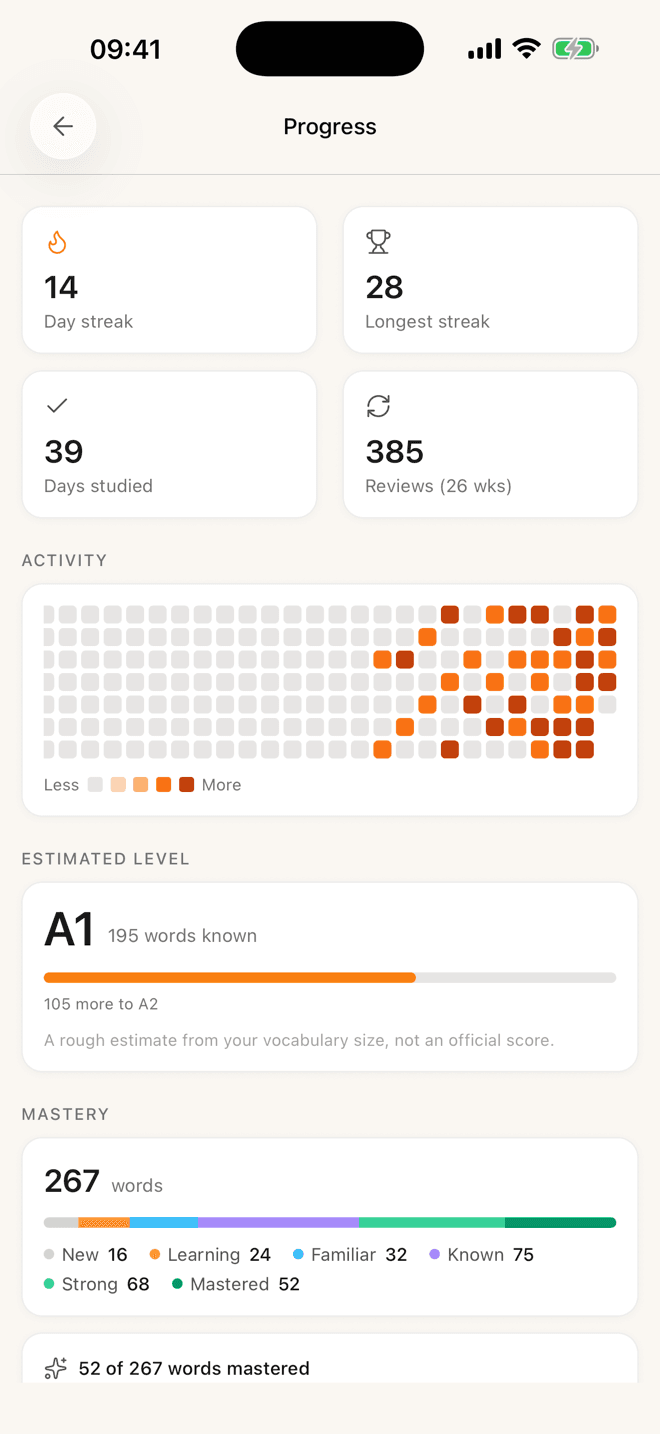
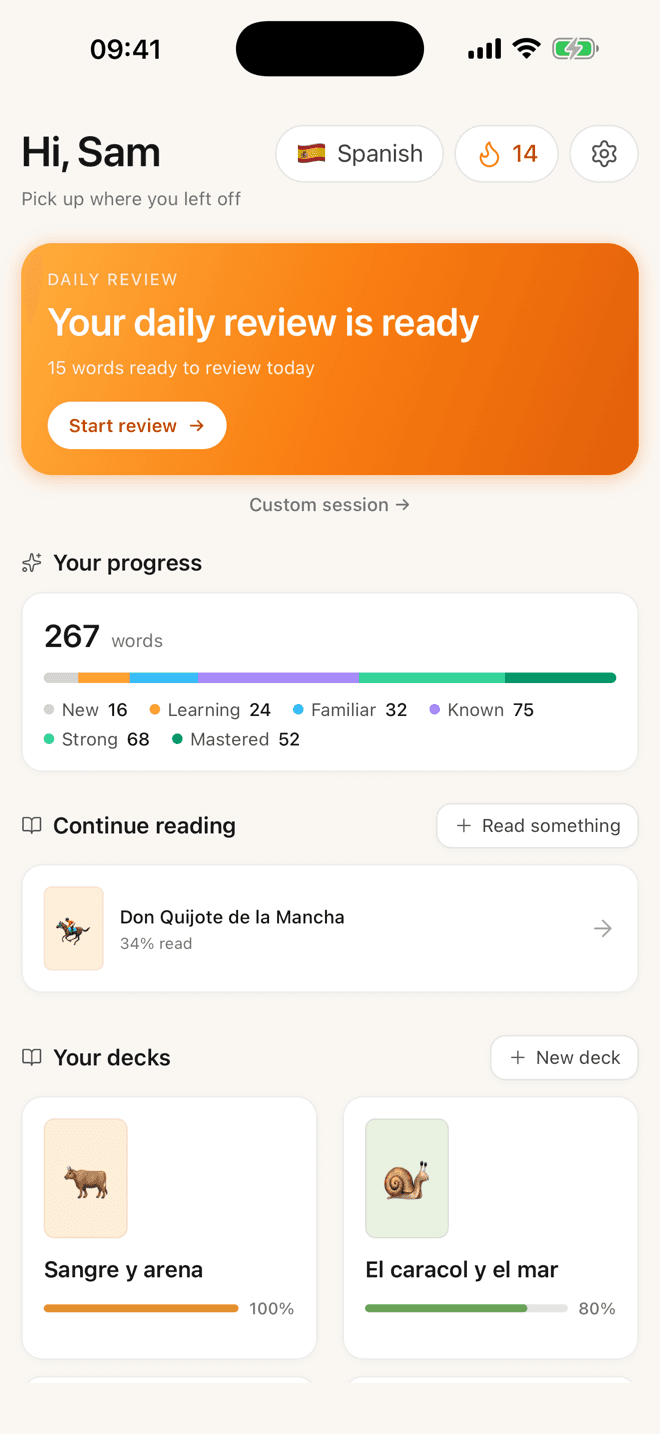
- Mark the word — a tap, a highlight — and keep reading in the same breath.
- Let context carry you past anything that is not blocking the sentence.
- Let the marked words come back to you later, on their own schedule.
- Accept that you will not learn every word you meet. You do not need to.
- Switching to a dictionary app mid-paragraph.
- Writing words into a notebook you will process “on Sunday”.
- Rereading a sentence four times to extract every drop before moving on.
- Looking up a word you could have inferred, because you like being certain.
Choosing material without wasting a month
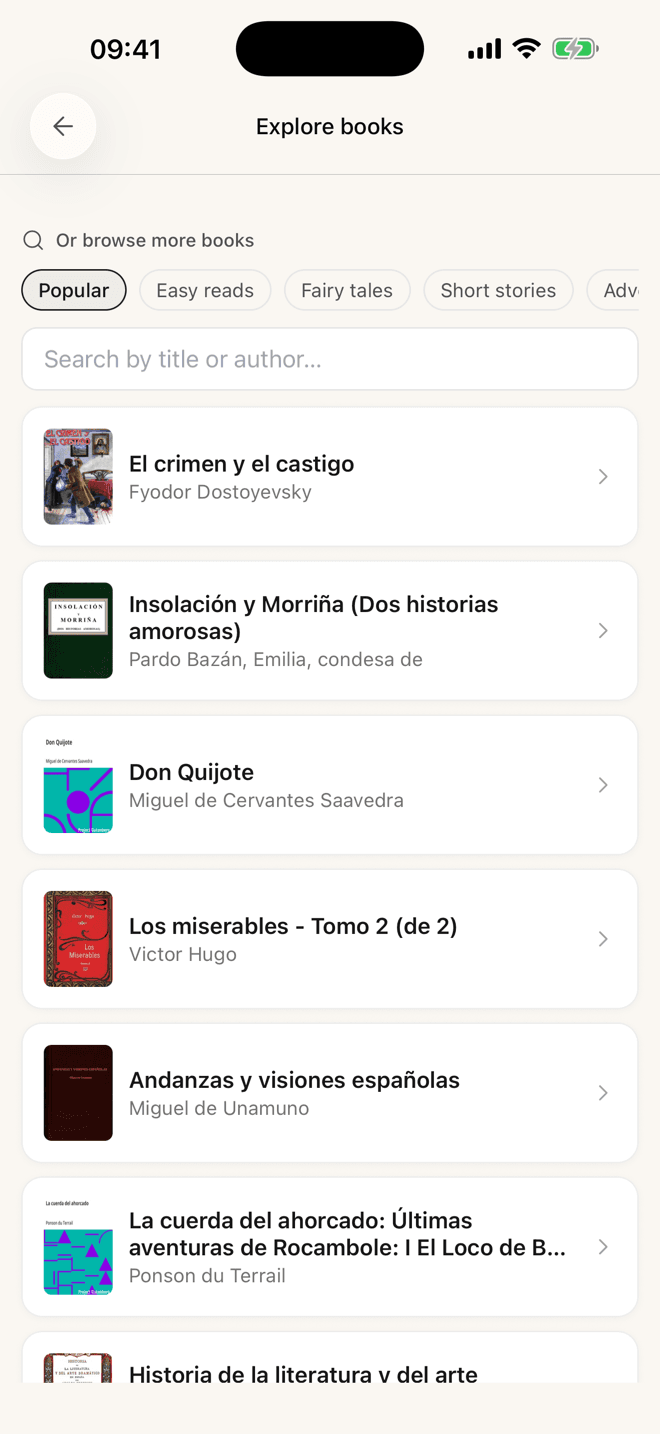
- Test the page, not the blurb. Open somewhere in the middle, read a page, count the blanks. Three to eight per page is the zone. There is a longer version of this test in the piece on picking a first book.
- Books with sequels are worth double. Vocabulary repeats inside an author’s body of work, and heavily. The second Camilleri is noticeably easier than the first. By the fifth you are coasting, and coasting through a novel in another language is exactly the experience you are trying to buy.
- Something you have already read is worth triple. You already know the plot, so all your capacity goes to the language instead of to working out what is happening.
- Do not overlook articles. A 1,200-word op-ed is a complete session with a beginning and an end. Three a week compounds just as well as a novel and never sits half-finished on a shelf reproaching you.
A weekly rhythm
- 1Five minutes, most mornings
Yesterday’s words come back. Grade honestly, stop when the queue empties. This is the part that turns reading into retention.
- 2Twenty minutes, anywhere
Read. Tap what you do not know without stopping. Flow is the objective; the tapping should cost you nothing.
- 3One day off
Genuinely. Spaced repetition tolerates a missed day fine, and recovery beats burnout by a distance.
Do not import everything
When people first discover that a tool can pull vocabulary out of a text automatically, the instinct is to feed it everything they have ever read. Resist it.
A word that appeared once in a footnote does not deserve a slot in your daily review for the next two years. Neither does a proper noun, or a piece of period vocabulary from a novel written in 1890 that you will never encounter again. Every card you add is a small recurring tax on every future session.
My own rule, arrived at after drowning myself once: if I cannot imagine meeting the word again in the next month, it does not go in.
The reading-versus-flashcards argument that flares up periodically is a false fight, and both camps are describing half of one process. Pure input without any deliberate retrieval works — it just needs a volume of hours most working adults do not have. Pure flashcards without input builds a vocabulary you cannot deploy.
What actually works for someone with a job is input as the engine and a small, honest review habit as the ratchet that stops it slipping back. Twenty minutes reading, five minutes reviewing. That ratio is not arbitrary — reading is where the learning happens, and the review exists only to stop you paying for the same word twice.
Questions people ask about this
- How much should I read a day?
- Twenty minutes, most days, beats two hours on a Sunday by a wide margin — for the same reason spaced repetition beats cramming. If twenty is not happening, ten is not a failure. The number that matters is how many days you did something, not how long each one was.
- Should I read out loud?
- It helps pronunciation and hurts volume, since you read far more slowly. I would do a paragraph or two out loud at the start of a session and then read silently, rather than choosing one.
- Do audiobooks count as input?
- They count, and they train a different and badly neglected skill. They are much harder to control though — you cannot slow a sentence down without losing the thread. Reading and listening to the same book together is the strongest version of this if you have the patience.
- Is it a problem if I do not understand everything?
- It is the expected state, and getting comfortable in it is one of the skills you are building. If you understand every word, the text is too easy to teach you anything. Somewhere around two unknown words a paragraph is where the learning lives.
What compounding actually looks like
The pleasant surprise in year two is that adding fewer cards per chapter is the goal, not a sign of stalling. It means the text finally belongs to you.
That is the whole cheat code, and I have not found another one. The mechanics of keeping what you read are in the spaced repetition piece.