Reading Lord of the Rings in Spanish: what eight months looked like
I moved from Berlin to San José with ten-year-old school Spanish and a 1,200-page paperback. This is the actual routine — including the month I wasted, the thing I got wrong about listening, and what I would tell myself on the plane.

- Four weeks of base vocabulary before touching the novel. Skipping this is why my first attempt failed.
- A book I had already read three times in English, so the plot carried me while the language did not.
- Five minutes of review with the morning coffee. Twenty minutes of reading whenever.
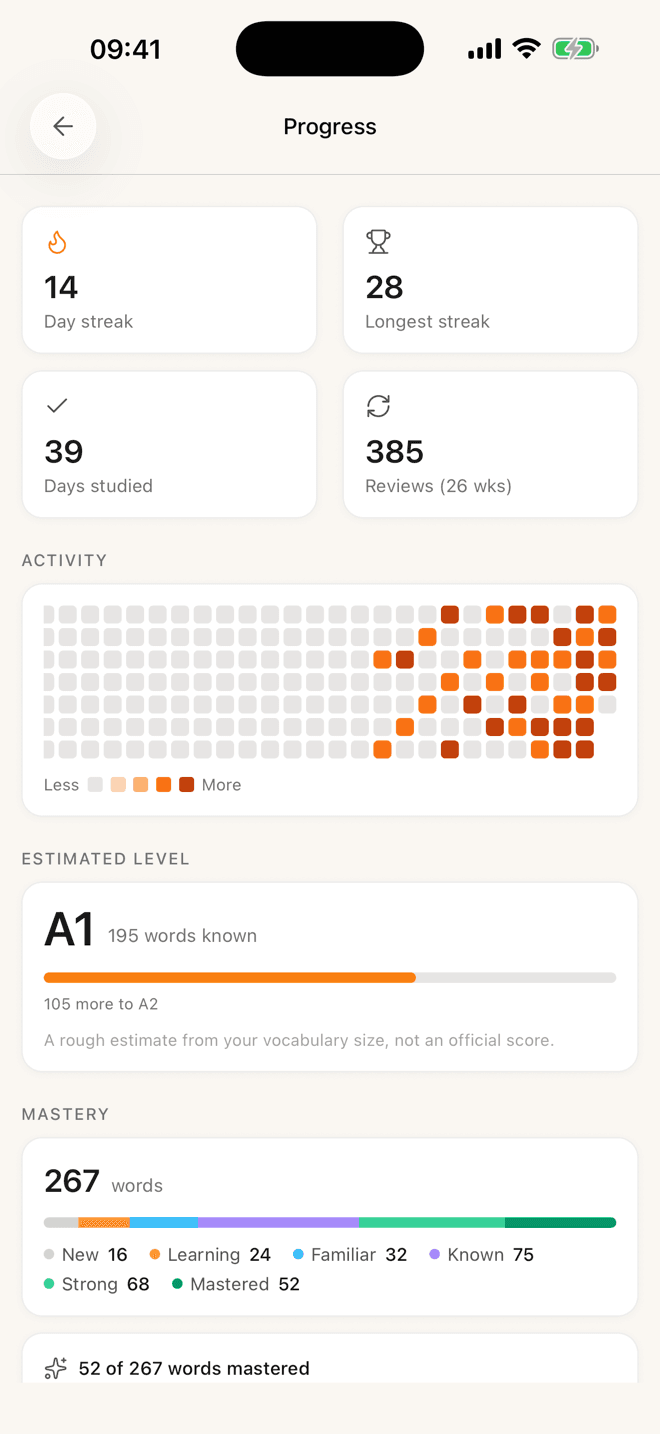
- Eight months in: about 3,400 active cards, volume one finished, and listening still lagging badly behind.
Eight months ago I moved from Berlin to San José. My Spanish was ten-year-old school Spanish: I could conjugate tener on a good day, I knew what cerveza meant, and I could read a menu if it was printed clearly and the waiter was patient.
Nothing that would survive a real conversation about, say, why the water was off again. Which it was, frequently, in that first month.
The plan was the one that has worked for serious learners forever: read a lot, every day, for a year. The problem was that every tool for doing it annoyed me enough that I stopped. I tried Anki three separate times. I tried pop-up dictionaries. None of it survived contact with an actual evening.
So I built the thing I wanted, and this is the routine I am actually running.
Why Tolkien, in Spanish
Two reasons, and only one of them is romantic.
First, I have read it three times in English over twenty years. The story is already in my head, so every cycle I am not spending on following the plot goes to the language instead. When a sentence collapses on me I still know what happened in it.
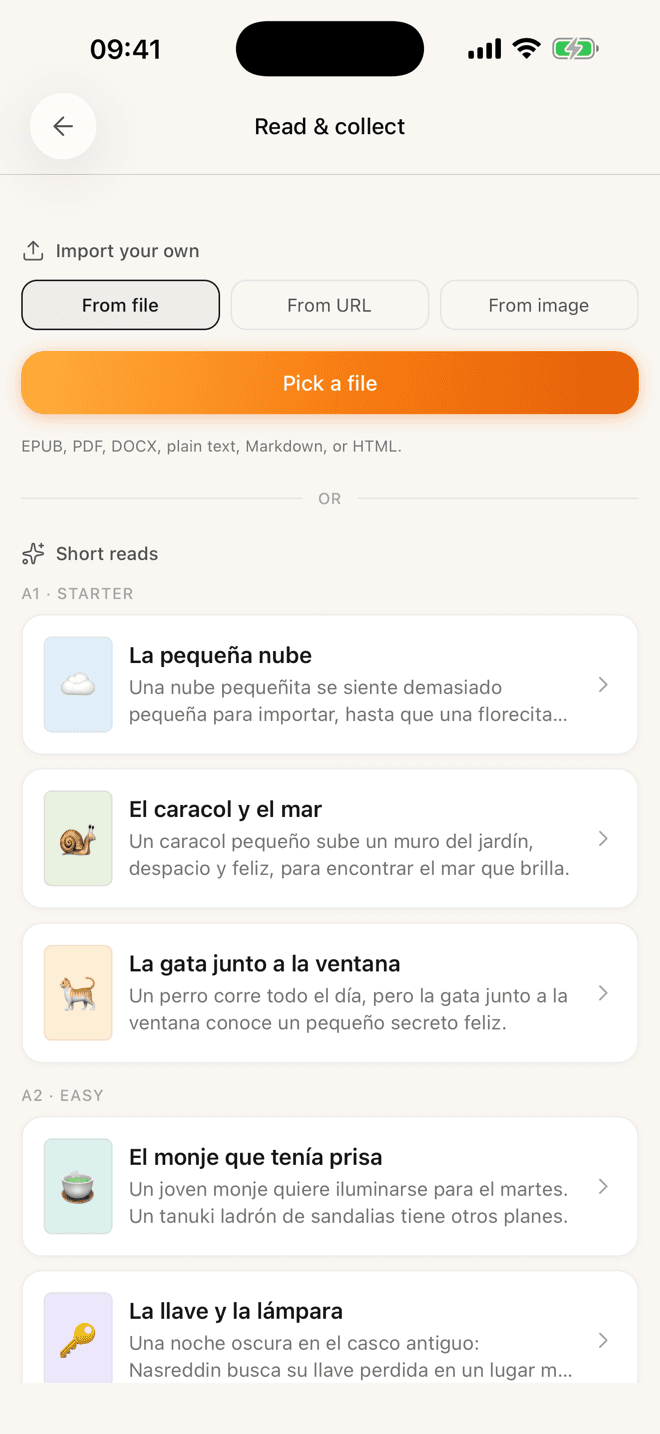
Second, it is enormous. Twelve hundred pages across three volumes — six to nine months of evenings with the same translator, the same register and the same recurring vocabulary. That repetition is the actual mechanism. A word I meet forty times across a trilogy is a word I own without ever studying it deliberately.
The Spanish translation is literary and faintly archaic and gorgeous, and it is comfortably B2. At month one that was a problem.
The month I wasted, and the four weeks that fixed it
I opened volume one cold at A2. I drowned in the first chapter, concluded I was not ready, and put it down for a month feeling like an idiot.
I was not unready. I had picked the wrong entry point, which is a different and much cheaper mistake. Before going back to Tolkien I spent four weeks on base vocabulary — frequency-ordered, boring, 25 new cards a day, every morning over coffee.
Four weeks later I had roughly 700 solid cards, mostly verbs and connectives, and I could read children’s books out loud to my partner without stopping every line. That sounds trivial written down. It was the single highest-leverage month of the whole project.
Nothing in this whole endeavour has paid off like four weeks of deliberately boring vocabulary before the interesting part.
What a chapter actually looks like now
This is the part that changed most since I started, because the app changed. It used to be: read the chapter, highlight things, batch-import on Saturday, process a list. That worked, but the Saturday session was a chore, and chores get skipped.
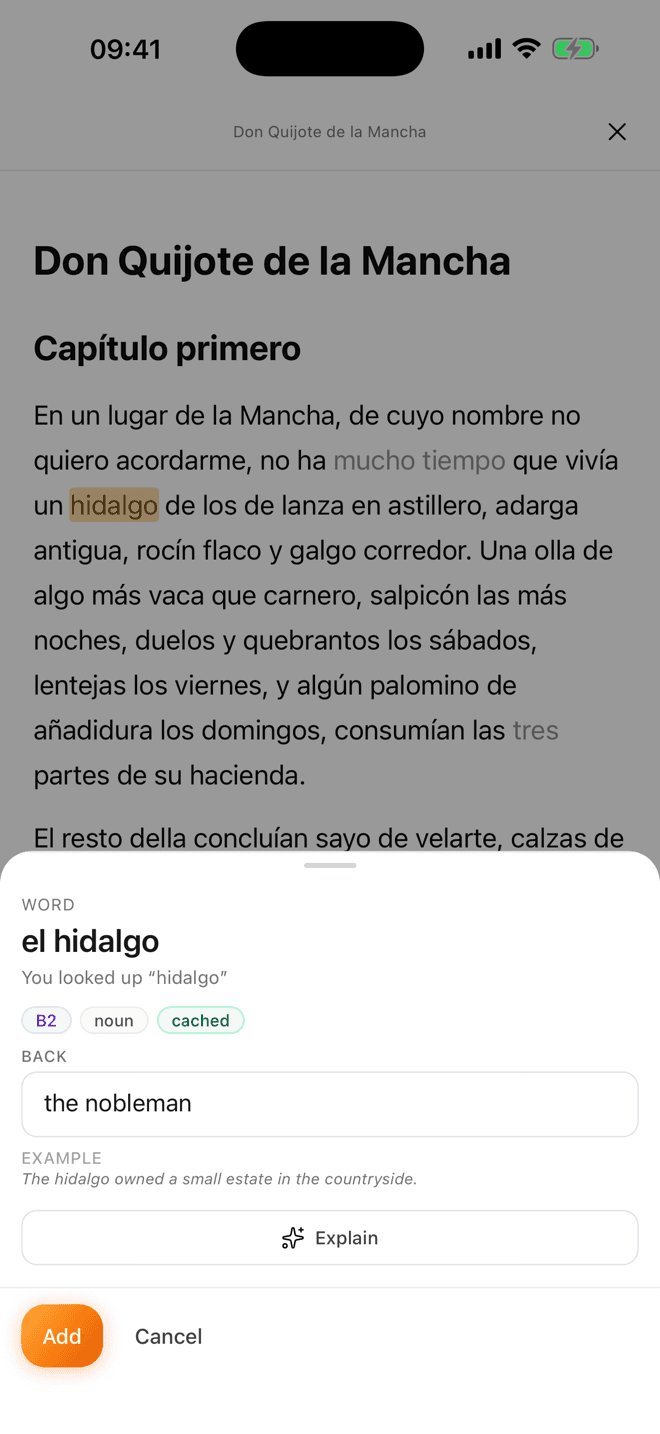
Now the reading and the collecting are the same action. I open the chapter in the reader, and when I hit a word that blocks the sentence I tap it. Translation, part of speech, the level, an example. If the grammar is the confusing bit rather than the word — which with Tolkien is often — I tap Explain and get a sentence about what that verb form is doing there. Then I add it and the card gets out of the way, and I am back in the paragraph.
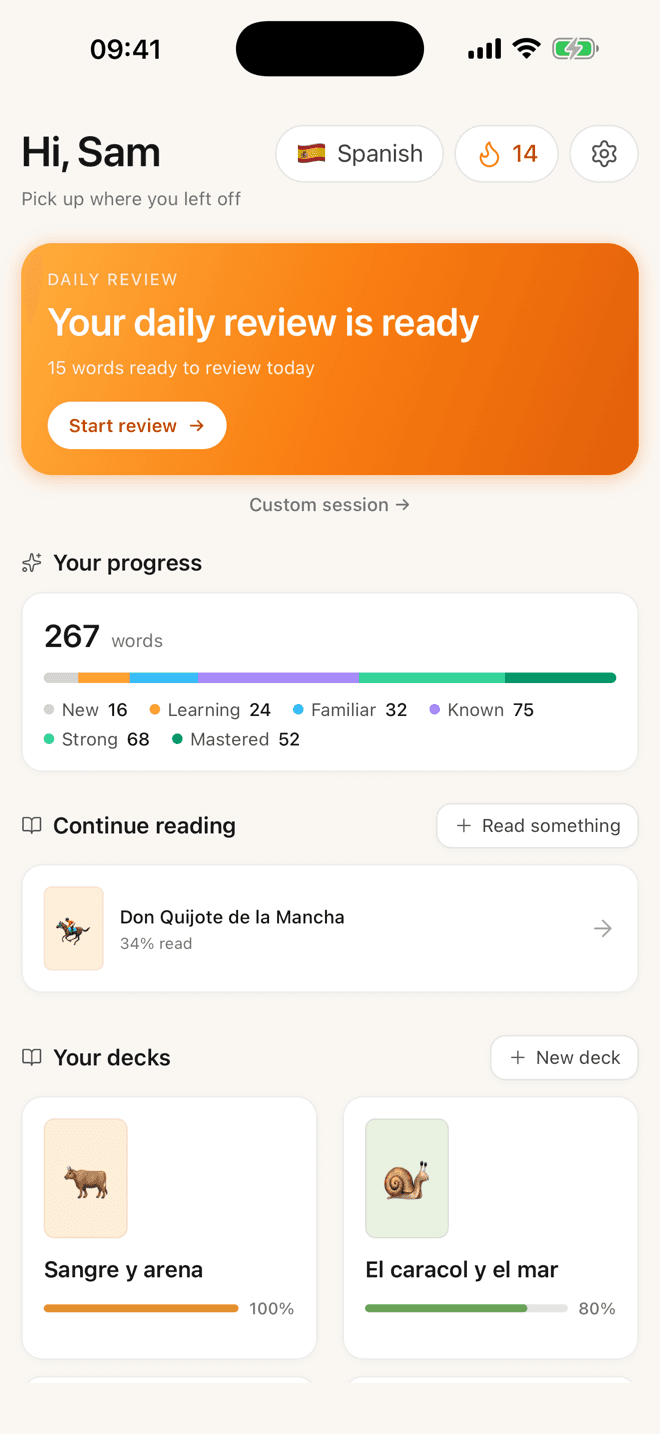
The words I tapped last night turn up in tomorrow morning’s review without me organising anything. Removing that Saturday session is the only reason this habit survived past month three.
The daily rhythm, honestly
- Five minutes of review on the patio with coffee, before the dog needs out.
- Mixed direction — half the cards Spanish → English, half the other way.
- Twenty minutes of reading on the bus, in a queue, or in bed.
- Tap the word, keep going. Never stop to be thorough.
- A structured evening study block. Never happened once.
- Grammar exercises alongside the reading. Bought the book. Still shrink-wrapped.
- Reviewing twice a day for faster progress. Tried it, learned nothing, was tired.
- Reading only in Spanish. I still read in English and German, and that is fine.
The reverse direction is the part I would defend hardest. It is slower and more annoying and it is where speaking actually lives. A deck that only ever asks you to recognise words lets you believe you know things you cannot produce, and that illusion holds right up until someone asks you a question in a bakery.
Between meetings I sometimes run a typing round instead — same cards, but I have to spell the Spanish. It is humbling, and it finds every word I “kind of” know.
The street vocabulary problem
Tolkien is teaching me sortilegio and arboleda. San José is teaching me pulpería and casado and pura vida. These are close to disjoint vocabularies and I need both.
The book stream takes care of itself. The street stream I have to catch deliberately — a photo of a hand-written notice at the bank, a word my landlord used for a plumbing part that I said into the app on the walk home because I would absolutely have forgotten it by dinner.
Costa Rica is a country with a lot of things still printed on paper, so the camera earns its place more than I expected it to when I built it.
Month eight: the scoreboard
What is working
- I am past the wall. The friction drops chapter by chapter as the recurring vocabulary becomes mine. This is the compounding everyone promises and it does arrive, just later than you want it to.
- The dictionary panic is gone. I used to reach for my phone every page. Now maybe once a chapter, and usually out of curiosity rather than necessity.
- I have not burned out. Eight months. Five minutes a day genuinely means five minutes, and skipping a Sunday does not bankrupt anything. That would have been unimaginable for me with Anki, which I quit three times.
What still does not work
- Listening lags embarrassingly. A TV news anchor is fine. A friend telling a story over loud reggaeton is not. Reading will not fix this and I knew that going in — it needs conversation hours I have not paid.
- The subjunctive. I recognise it instantly when I read it and rarely produce it correctly under pressure. That is a grammar gap, and no amount of vocabulary closes it.
- Register. Knowing aciago and hostigamiento is excellent for the book and useless at the panadería. If you only read literary fiction you will end up sounding like a translated novel, which is a genuinely odd thing to sound like.
The advice I would give past-me on the plane is not about tools at all. It is: pick something long, and stay with it far past the point where switching to something easier feels sensible.
Almost everyone I know learning a language is on their fourth resource. New app, new method, new course, each one restarting the clock on the vocabulary that only pays off through repetition. The boring answer — one long book, one small daily habit, for months — is boring precisely because it works and there is nothing to optimise once you have started.
Four things I would tell myself
- Do the boring four weeks first. Base vocabulary before the novel is the difference between drowning in chapter one and floating through it.
- Pick a book you already know. Re-reading a translated favourite is the cheat code and I would not have finished volume one without it. More on choosing in the first-book piece.
- Add fewer words than you want to. The cards you add today are reviews you will do for two years. A chapter that gives you forty words you care about beats one that gives you three hundred you will resent on a Wednesday.
- Use both directions from day one. Recognition-only lets you fool yourself for months.
None of this is clever. Read a chapter, tap what you do not know, spend five minutes the next morning. The software’s only job is to get out of the way so the reading gets in — which is the whole reason Lemnly exists, and most of what I think about when I build it.