The forgetting curve is a timetable, not a diagnosis
Everyone quotes Ebbinghaus at you to explain why you forget. Almost nobody explains the part that matters: the curve changes shape every time you use it. Here is what that means for your five minutes a day.

- Forgetting fast is normal and it is not a memory problem you need to fix.
- Every successful recall flattens the next decline. That is the whole mechanism.
- So the useful question is never “how do I stop forgetting” — it is “when should I come back?”
- Practical version: one short session a day, honest grading, and stop when the queue is empty.
The forgetting curve gets quoted at learners constantly, and almost always as bad news. You lose most of what you learned within a day. Within a week it is nearly all gone. Ebbinghaus proved it in the 1880s by memorising nonsense syllables and testing himself, which is either heroic or a cry for help.
The bad-news version is true. It is also the least interesting thing about it.
The part nobody puts on the slide
The famous chart shows one curve. One study session, one decline. But nobody learns anything once. What actually happens when you review is that the curve redraws itself, shallower each time.
Look at the gaps along the bottom. They get wider. That is not the scheduler being generous with you — it is the scheduler tracking a real property of the memory, which gets more durable each time you successfully drag it back up.
You are not fighting the curve. You are riding it, and each ride makes the next one longer.
Three things the curve leaves out
The textbook version flattens some detail that matters much more than the shape of the line.
Words are not equally hard. Some cards fight you for months. In my Spanish deck the offenders are almost all abstract nouns and near-synonyms — I lost about six weeks to acercar versus acertar before they separated. A card for caballo was solid after three reviews. A good scheduler models this per card rather than assuming your memory treats them the same, because it very obviously does not.
Context does a lot of the lifting. A word recalled naked on a flashcard decays faster than the same word recalled with the sentence you first met it in. This is not a nice-to-have. It is why I made Lemnly attach the source sentence automatically instead of leaving it as an optional field that nobody fills in — an optional field that nobody fills in is a feature that does not exist.
Failing is not wasted. Trying to recall something and coming up empty still strengthens the memory when you then see the answer. This is counterintuitive and well established, and it is the reason you should think before flipping the card, even when you are fairly sure you have no idea.
What this means for a Tuesday
Concretely, the routine. It really is about five minutes.
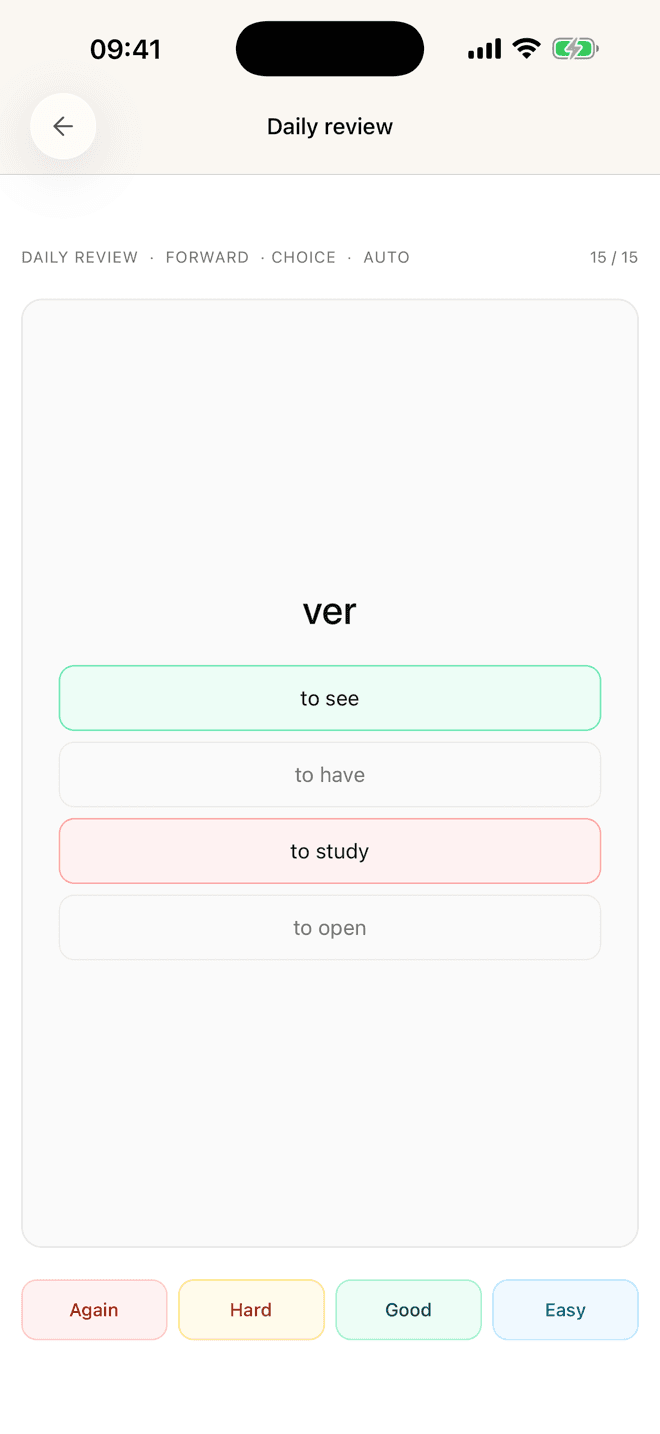
What a session actually looks like: whatever the scheduler decided is near the edge of your memory today, and nothing else.
- One session a day, at whatever time you will actually do it. Mine is with the first coffee.
- Attempt the answer in your head before revealing it, even when you are sure you do not know.
- Grade honestly. “Again” when you did not know it, not when you feel bad about knowing it slowly.
- Stop when the queue is empty. The session ending is the feature.
- A second session three hours later. Nothing is due yet; you are reviewing cards you already knew.
- Grading “Good” to keep your stats tidy. You are only lying to the scheduler about your own memory.
- Adding fifty new words the night before a trip.
- Reviewing while half-watching something. Retrieval needs the attention; that is the whole active ingredient.
Why “just one more round” backfires
This one took me embarrassingly long to accept, because more practice feeling like more progress is a very hard intuition to shake.
A scheduler puts each card near the edge of your forgetting curve. Do a bonus session three hours later and almost nothing is near that edge. You will get nearly everything right, which feels excellent, and you will have learned nearly nothing — while burning the willpower you needed for tomorrow, when the cards genuinely are due.
One five-minute session a day beats two ten-minute sessions every other day. Not by a little.
When you fall off it entirely
You will miss a week. I missed nearly three when I moved house, and came back to a backlog that made me want to close the app and never open it again.
What actually works, having done it wrong first:
- Spread the backlog over three or four days rather than clearing it in one grim sitting. The sitting is how people quit.
- Expect a lot more “Again” than usual, and do not read it as evidence that the last six months were wasted. Stability recovers much faster than it built.
- Add no new cards until the backlog is gone. New cards on top of a backlog is the classic Anki death spiral, and no amount of good scheduling saves you from it.
The framing most apps use — streaks, “don’t break the chain”, a cartoon animal looking disappointed — is aimed at the wrong problem. It treats showing up as the hard part. For anyone past the first month, showing up is not the hard part. Coming back after you stopped is.
A tool that makes you feel awful for missing four days is optimising for the four days and losing you the next four years. That is why Lemnly has a streak counter you can look at and nothing that punishes you for a gap in it.
Questions people ask about this
- Is the forgetting curve actually real, or pop science?
- The basic finding — rapid initial decline that flattens — has replicated many times since 1885, including a well-known 2015 replication. What is pop science is the precise curve people reproduce on slides, usually copied from a single dataset of one man memorising nonsense syllables. Treat the shape as real and any specific percentage as decorative.
- How long should the gaps between reviews be?
- You should not be deciding this. The whole point of a scheduler is that the right gap depends on how well that particular card is holding for you, which is not something you can eyeball across a few thousand words. If you are doing it by hand, expanding roughly — a day, three days, a week, a fortnight, a month — is the classic approximation.
- Does re-reading work instead of testing myself?
- Much less well, and it feels better, which is the trap. Recognising a word on the page is easy and produces a strong sense of knowing it. Retrieving it from nothing is hard and is what actually strengthens the memory. If a method feels comfortable, be suspicious of it.
- What if I forget a word every single time?
- After six or seven failures, the card is usually the problem rather than you. Either it is too abstract to hold on its own, or it is tangled with a similar word. Fixes that work: add an image, rewrite the example sentence to something ridiculous and personal, or delete it and let the word come back to you through reading instead.
So: a timetable
Read the curve as a schedule, not a verdict. It is not telling you your memory is bad. It is telling you when returning to a word is worth the thirty seconds, and when it is not.
Working out that timing by hand for three thousand words is impossible, which is what the scheduler is for. If you want the argument for FSRS specifically over the older algorithms, that is in the spaced repetition piece. If you want the vocabulary numbers all this is in service of, they are in the thresholds article.